The Leadership Investment Challenge
In today's challenging economic landscape, every investment demands justification. Leadership development programmes, despite their critical importance, aren't exempt from this scrutiny. The question increasingly asked in boardrooms isn't whether leadership training is valuable, but rather: "What tangible return are we getting from our investment?"
This shift in perspective represents both a challenge and an opportunity. While measuring the impact of leadership development has traditionally been difficult, organisations that master this evaluation process gain significant competitive advantages—they can refine their approaches, allocate resources more effectively, and demonstrate concrete value to stakeholders.
"Not everything that counts can be counted, and not everything that can be counted counts." — Albert Einstein
This quote perfectly captures the complexity of measuring leadership training ROI. The most valuable outcomes often seem the most elusive to quantify. However, with the right framework and metrics, organisations can indeed transform learning experiences into measurable business results.
Beyond the Feedback Form: A Comprehensive ROI Framework
Traditional approaches to evaluating leadership training often stop at participant satisfaction surveys or knowledge assessments. While these provide immediate feedback, they fail to capture the true business impact of leadership development initiatives.
A more robust approach requires a multi-layered evaluation framework:
1. The Phillips ROI Methodology
The Phillips ROI Methodology offers a comprehensive five-level approach to measuring training effectiveness:
Level 1: Reaction and Planned Action
Measures participant satisfaction and initial commitment to applying what they've learned.
Level 2: Learning and Confidence
Assesses knowledge gained and confidence in applying new skills.
Level 3: Application and Implementation
Evaluates how effectively participants apply their learning in the workplace.
Level 4: Business Impact
Measures how the applied learning affects key business metrics.
Level 5: Return on Investment
Compares the monetary value of business impacts against programme costs.

2. Balanced Scorecard Approach
This approach examines leadership development impacts across four perspectives:
- Financial: Revenue growth, cost reduction, profit margins
- Customer: Satisfaction scores, retention rates, new customer acquisition
- Internal Processes: Efficiency metrics, quality improvements, innovation rates
- Learning & Growth: Employee engagement, retention of key talent, succession planning readiness
By using both frameworks, organisations can develop a comprehensive picture of their leadership training ROI that balances short-term impacts with long-term strategic value.
Key Metrics That Matter: Quantifying Leadership Development Impact
While the specific metrics will vary based on organisational goals, several key indicators consistently demonstrate leadership development ROI:
Productivity Metrics
- Team output: Measurable increases in team productivity
- Project completion rates: Improvements in on-time, on-budget delivery
- Quality improvements: Reduction in errors or customer complaints
- Innovation metrics: New ideas implemented or process improvements
People Metrics
- Employee engagement scores: Improved workplace satisfaction and commitment
- Retention rates: Decreased turnover, particularly among high-performers
- Succession readiness: Increased bench strength for key positions
- Internal mobility: More promotions from within versus external hiring
Performance Metrics
- Revenue growth: Attributable increases in sales or market share
- Cost reductions: Operational savings from improved leadership
- Customer satisfaction: Improved NPS scores or reduced complaints
- Strategic goal achievement: Faster or more effective execution of key initiatives
The ROI calculation itself follows a straightforward formula:
ROI (%) = [(Net Programme Benefits - Programme Costs) ÷ Programme Costs] × 100
Where "Net Programme Benefits" represents the monetary value of all positive outcomes minus any negative outcomes, and "Programme Costs" includes all direct and indirect expenses associated with the training.
From Theory to Practice: Implementing Effective ROI Measurement
Measuring ROI effectively requires thoughtful planning and execution. Here's a practical roadmap:
1. Begin with the End in Mind
Before launching any leadership development initiative, clearly define what success looks like in measurable terms. Work backwards from organisational goals to determine which leadership capabilities will drive those outcomes.
"What gets measured gets managed." — Peter Drucker
This clarity ensures your metrics align with strategic priorities rather than measuring what's merely convenient.
2. Establish Baselines and Control Groups
To accurately measure impact, you need to know your starting point. Collect baseline data for all relevant metrics before training begins. Where possible, use control groups (similar teams or individuals who don't receive the training) to isolate the impact of your leadership development efforts from other variables.
3. Implement a Mixed-Methods Approach
Combine quantitative and qualitative measurement techniques:
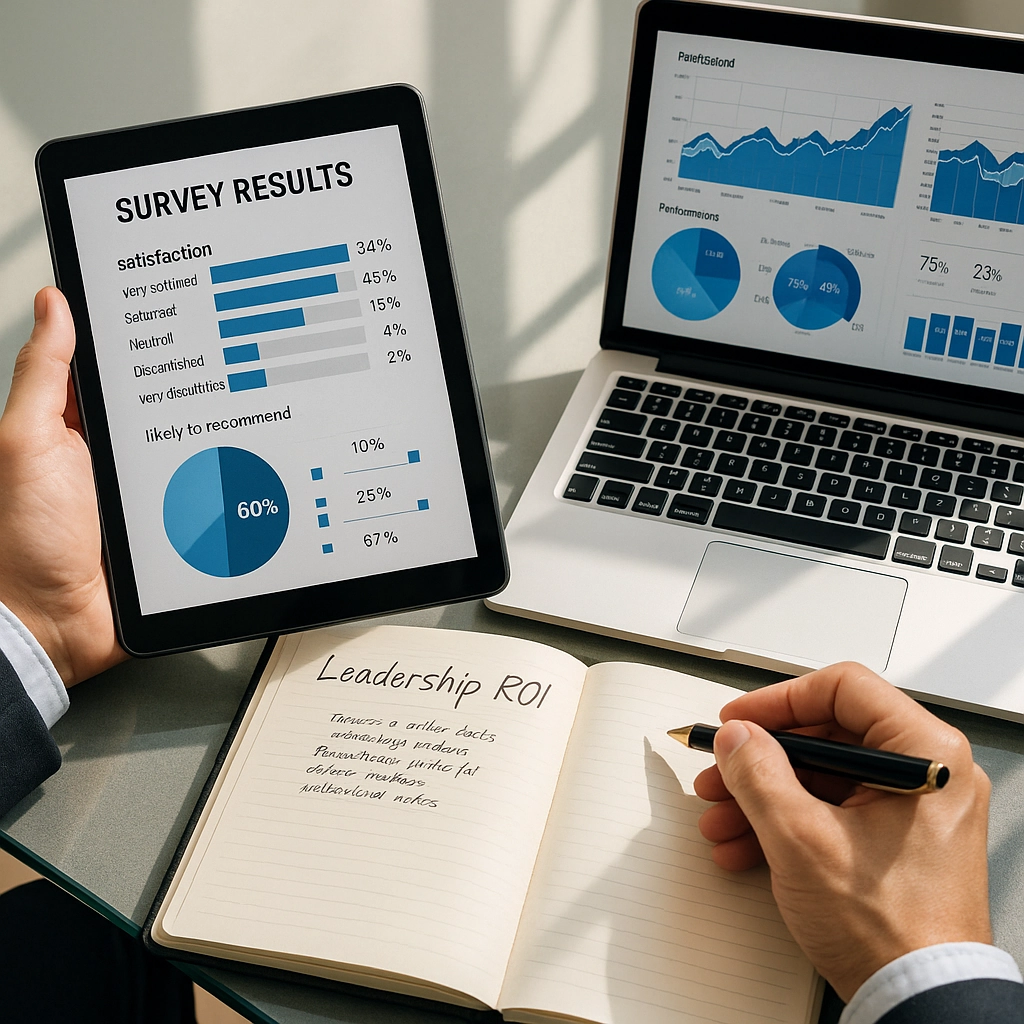
- Surveys and assessments: Pre/post measurements of leadership capabilities
- 360-degree feedback: Perspectives from multiple stakeholders
- Performance data analysis: Hard metrics from business operations
- Interviews and focus groups: In-depth qualitative insights
- Observation: Structured workplace observation of leadership behaviours
4. Isolate the Effects of Training
Several techniques help separate the impact of leadership development from other factors:
- Control group analysis: Compare participants versus non-participants
- Trend line analysis: Project previous trends forward and compare to actual results
- Expert estimation: Have knowledgeable stakeholders estimate the percentage of improvement attributable to training
- Participant self-assessment: Ask leaders to estimate the impact of their development on specific outcomes
5. Convert Impacts to Monetary Value
To calculate ROI, you must assign financial values to the benefits. Some approaches include:
- Direct conversion: Some metrics (sales, costs) already have monetary values
- Historical costs: Using past data to value improvements (e.g., cost of turnover)
- External databases: Industry standards for various business impacts
- Internal experts: Finance team estimates of the value of certain improvements
Real-World Success: Leadership Development ROI in Action
At LMI-UK, we've seen firsthand how effective leadership development creates measurable returns. For instance, one healthcare organisation implemented our leadership programme with a key physician leader who subsequently transformed her productivity and leadership effectiveness. The results included:
- 30% increase in productive time through improved delegation
- Enhanced team morale and reduced conflicts
- Streamlined clinical processes resulting in more patients seen per day
Similarly, our work with Middlesex in the Community demonstrated how leadership development directly impacts organisational productivity, with measurable improvements in team performance and project delivery.

Overcoming Common ROI Measurement Challenges
Despite its importance, measuring leadership development ROI presents several challenges:
Challenge 1: Attribution
Leadership impacts are often diffused throughout the organisation and influenced by multiple factors. Solution: Use control groups and isolation techniques to separate training effects from other variables.
Challenge 2: Time Lag
Some leadership development benefits take months or years to fully materialise. Solution: Implement milestone measurements at regular intervals and track leading indicators that predict longer-term outcomes.
Challenge 3: Intangible Benefits
Many leadership impacts (improved culture, better decision-making) resist easy quantification. Solution: Develop proxy measures and supplementary qualitative assessments to capture these benefits.
Challenge 4: Data Collection Burden
Extensive measurement can create administrative overhead. Solution: Focus on the most meaningful metrics and automate data collection where possible.
Conclusion: From Investment to Strategic Advantage
In today's resource-constrained environment, demonstrating leadership development ROI isn't optional—it's essential. By implementing a robust measurement framework, organisations can:
- Make more informed decisions about leadership development investments
- Continuously improve programme design and delivery
- Demonstrate tangible value to senior leaders and stakeholders
- Transform leadership development from a cost centre to a strategic driver of organisational success
The organisations that master this process gain significant competitive advantages: they develop leaders more effectively, allocate resources more efficiently, and create a culture where leadership development is recognised as a critical business investment rather than a discretionary expense.
At LMI-UK, we partner with organisations to not only deliver exceptional leadership development programmes but also to implement the measurement frameworks that demonstrate their true value. By turning learning into measurable results, we help transform leadership potential into business performance.
To learn more about measuring the ROI of your leadership development initiatives, visit our website or explore our leadership development programmes.